Youth arts tutoring combines expert instruction and personalised mentorship to help young people develop creative skills, confidence and emotional expression. This article explains how targeted tutoring differs from general art classes, the specific benefits for motor skills, cognition and wellbeing, and how families and support workers can choose the right tutor. Readers will find practical comparisons of mediums (drawing, painting, digital), step-by-step portfolio development guidance, and evidence-informed notes linking creative practice to improved emotional regulation. The guide also outlines how to get started, what to expect from sessions, and how tutoring supports longer-term academic and career pathways. Throughout, the focus is on actionable guidance for parents, carers and support workers seeking quality youth creative arts tutoring and art classes for teens.
Youth arts tutoring accelerates creative development by combining deliberate practice, technique-focused feedback and mentorship aimed at skill mastery and personal expression. The focused structure of tutoring , often 1:1 or small-group mentorship , encourages repeated motor tasks, compositional problem-solving and reflective critique that translate into measurable skill gains. Recent research highlights links between arts education and improved executive function and emotional regulation in adolescents, reinforcing why targeted tutoring matters. Below is a concise list of the main benefit categories tutors prioritise for young learners.
Youth arts tutoring delivers core benefits:
The list above summarises the primary outcomes parents and support workers should expect, which leads into a practical mapping of how specific skills develop in tutoring settings.
Art practice maps to skill development in predictable ways:
Skill area | How it is developed | Typical tutor-led activities |
Fine motor skills | Repetitive, scaled technique practice | Pencil control drills, brushwork exercises |
Problem-solving | Iterative composition and critique | Thumbnail studies, value studies, project revisions |
Confidence | Visible progress and exhibition opportunities | Sequential projects, constructive feedback cycles |
Emotional expression | Non-verbal storytelling and reflective prompts | Themed prompts, process journals, mixed-media work |
Portfolio readiness | Focused pieces with selection criteria | Project briefs, refinement, presentation coaching |
This table shows how discrete tutor activities translate into developmental gains and prepares readers to evaluate lesson plans and tutor approaches. The next subsections examine motor and emotional benefits in more depth.
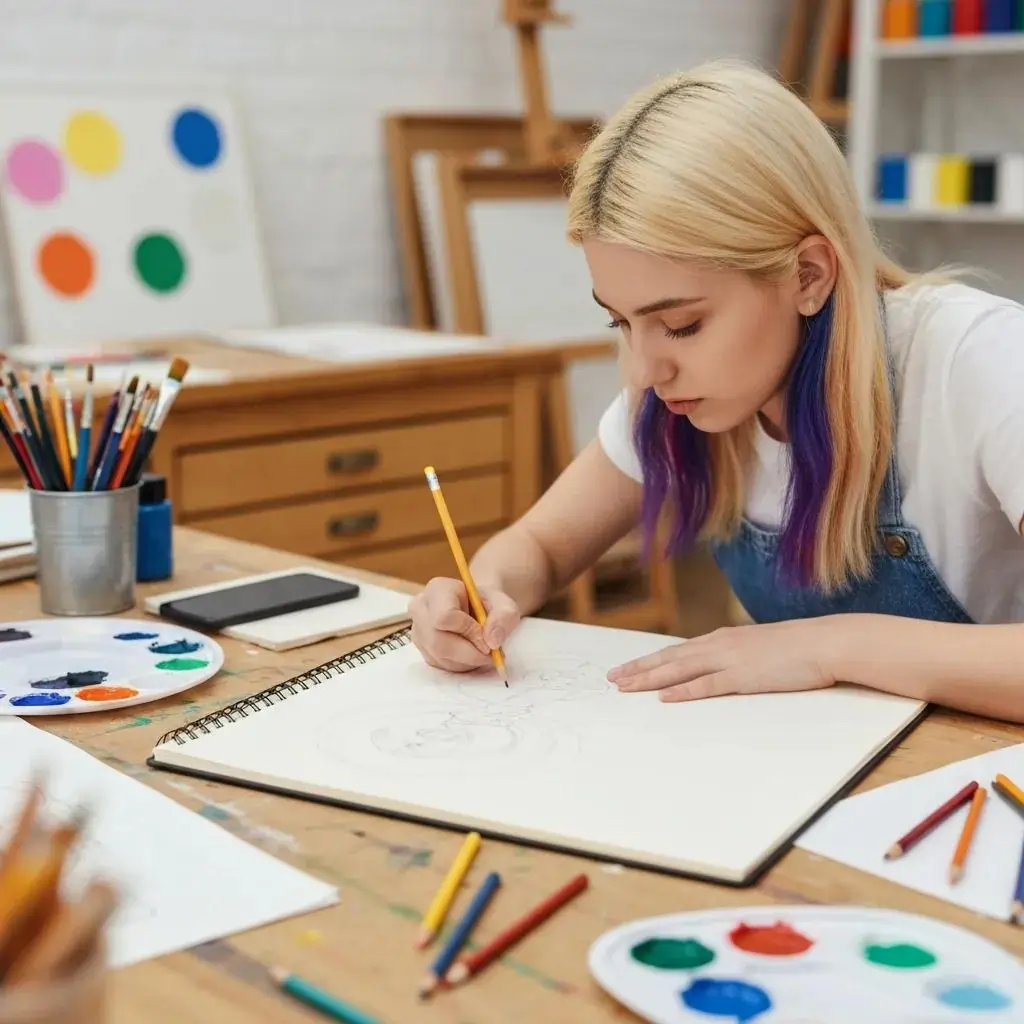
Fine motor development in youth occurs when tutors break skills into small, repeatable tasks that increase in complexity as competence grows. Tutors use exercises, such as contour drawing, hatch shading and controlled brush strokes, to train hand-eye coordination and pressure modulation, producing tangible improvements in control. Problem-solving develops alongside this motor work through composition studies that ask young artists to plan, test and refine visual decisions, which builds cognitive flexibility and project planning. These iterative processes mirror scientific learning cycles: skill rehearsal, feedback, reflection and adaptation, and they prepare young people for more advanced creative challenges.
Deliberate practice in tutoring therefore links physical control with cognitive strategies, and understanding that relationship helps families recognise effective lesson progression. The next section explores how those same tutoring dynamics boost confidence and emotional expression.
Art Therapy for Fine Motor and Cognitive Development in Children
This study investigated the influence of art and creative pursuits on the development of fine motor skills and cognitive capacities in young learners, with a specific focus on those who have experienced trauma. The results indicate that participation in art-based interventions can promote enhancements in both fine motor control and cognitive functions, thereby contributing to overall development and well-being.
Promoting Cognitive and Fine Motor Development in the Art Room for Young Students with Exposure to Trauma: an Exploratory Case Study, 2019
Creative arts tutoring creates safe spaces where young people practise self-expression and receive skill-focused feedback that validates progress and increases agency. Tutors structure tasks to produce visible milestones, sketches, developed pieces, small exhibitions, that allow learners to see measurable improvement, and this visible mastery drives self-confidence. Emotional expression benefits because art provides non-verbal channels to process feelings; tutors can use prompts and reflective conversation to help young people name emotions and translate them into imagery. Over time, that combination of mastery and expression supports improved self-regulation, greater willingness to take creative risks and clearer personal narratives in portfolios and presentations.
Linking confidence-building to practical session design helps families choose tutors who emphasise progress and psychological safety, which is the focus of the next H2 on types of tutoring.
Types of creative arts tutoring vary by medium, format and goal; choosing the right combination depends on whether the priority is foundational skill-building, portfolio development or wellbeing outcomes. Mediums such as drawing and painting develop foundational observational skills and fine motor control, while digital art and multimedia support contemporary career pathways and accessible remote learning. Formats range from 1:1 tutoring for targeted skill mastery to small workshops that prioritise social learning and collaborative projects. The comparison below helps match mediums and formats to typical youth goals.
Consider these medium-to-outcome pairings:
Medium | Best for | Outcomes / Age range / Format recommendation |
Drawing (pencils, charcoal) | Foundational skills | Observation, line control; all ages; 1:1 or small class |
Painting (watercolours, acrylics) | Technique & expressive colour | Brushwork, mixing; older children/teens; studio classes |
Pastels & mixed media | Texture & experimentation | Sensory exploration; younger children; workshops |
Digital art & multimedia | Portfolio & careers | Software skills, animation basics; teens; online or blended |
This table clarifies which mediums suit particular aims and suggests format recommendations that align with common learning objectives. The next subsections describe drawing/painting class types and how digital tutoring complements traditional media.
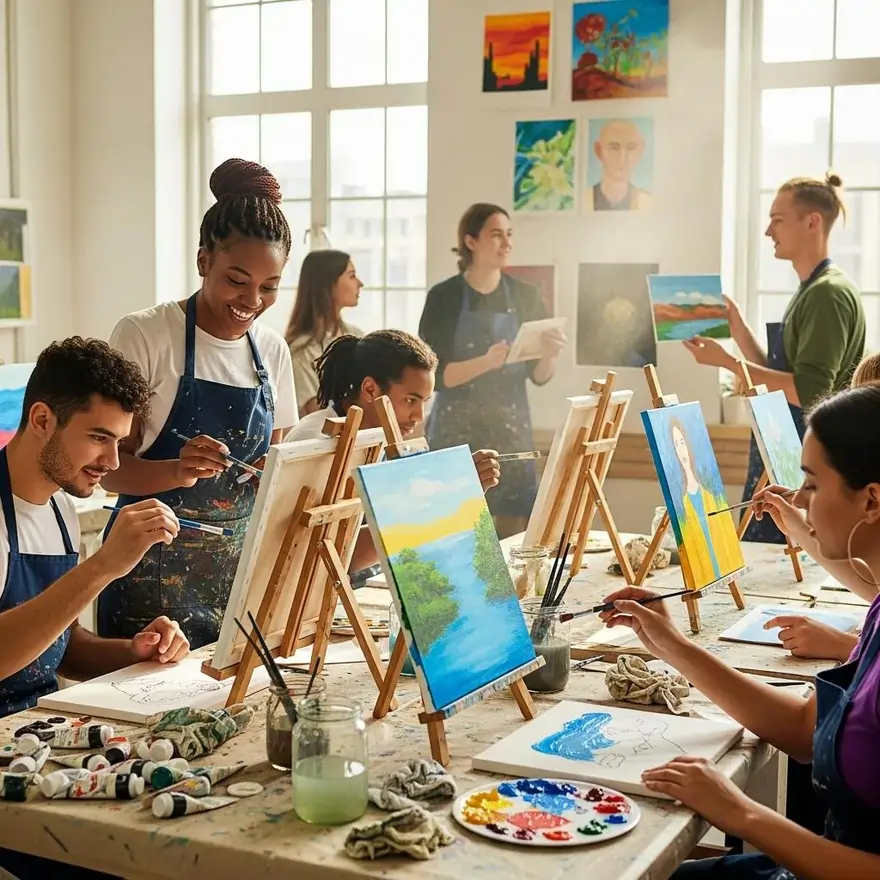
Drawing and painting classes for young people usually follow progressive curricula that begin with observational drawing, then advance to composition, colour theory and specialised techniques like watercolour washes or acrylic layering. Tutors design lessons so each term yields accessible pieces, sketchbook studies, finished paintings and contextual exercises that form the basis of a strong portfolio. Smaller group sizes or 1:1 formats allow tutors to personalise feedback on brushwork, mark-making and tonal control, which accelerates skill consolidation. Families should look for structured progression and clear examples of expected outcomes when evaluating class programmes.
Understanding curriculum structure helps caregivers select classes that balance technical training with creative exploration, which leads naturally to the role of digital media in modern tutoring.
Enhancing Fine Motor Skills in Early Childhood Through Arts and Crafts
Arts and crafts activities can be employed to improve children’s fine motor skills. These activities offer avenues for self-expression, or can be integrated as components of aesthetic and creative development. As art and craft engagement is intrinsically linked to the creation of artwork, it necessitates precision and adept coordination for the manipulation of small muscles, thereby developing fine motor abilities. The engagement of finger muscles, or fine motor skills, is fundamental to this process. The early development of these skills is crucial in preparing children for their subsequent transition into formal education.
Art and Craft Activities for Early Children To Improve Fine Motor Ability, M Mawardah, 2023
Digital art tutoring teaches software workflows, file management and multimedia storytelling that complement traditional studio skills and broaden career-relevant competencies. Tutors guide young people through projects such as digital illustration, basic animation or collage-based storytelling, which teach layering, colour correction and narrative sequencing. These skills increase accessibility, students can revise work easily and experiment without material waste, and they strengthen portfolios for contemporary creative pathways. Blended tutoring approaches that combine physical and digital media deliver the widest skill set and are especially useful for teens preparing work for university or creative industry opportunities.
Knowing when to blend digital and traditional media helps families choose formats that match long-term goals, which is discussed next when selecting a tutor.
Choosing the right art tutor requires evaluating qualifications, youth-specific experience, teaching approach and practical fit with the learner’s goals and needs. Effective tutors combine subject-matter expertise (art technique and portfolio knowledge) with youth mentoring skills, patience, clear communication and trauma-aware practice where relevant. Families and support workers should prioritise tutors who can show a structured lesson plan, sample progression, references to work with young people and an adaptable approach that supports confidence as much as technique. The checklist below helps guide conversations and trial sessions so that decision-making is practical and evidence-based.
Use this checklist when vetting tutors:
This checklist offers direct actions families can take before committing to lessons, and the table that follows clarifies tutor attributes and what to ask during an interview.
Tutor attribute | Why it matters | What to look for / example questions |
Youth experience | Ensures appropriate pacing and guidance | “Can you describe a recent lesson plan for a 12-year-old?” |
Teaching approach | Affects progress and emotional safety | “How do you give constructive feedback?” |
Portfolio coaching | Critical for university/career preparation | “Do you help select and present portfolio pieces?” |
Flexibility of format | Matches online/in-person needs | “Can you offer blended sessions or homework reviews?” |
Using this quick-reference table helps families structure interviews and compare candidates systematically. The next subsection explains specific qualifications and red flags to be aware of.
Meaningful qualifications for youth art tutors include formal study in art or design, demonstrable teaching experience with children and teenagers, and familiarity with portfolio requirements for further education. Equally important are soft skills: patience, the ability to scaffold tasks, and experience with mentoring or allied youth support, especially when working with vulnerable young people. Useful interview questions ask tutors to describe a recent lesson sequence, examples of students’ progress, and how they adapt tasks for different developmental needs. Red flags include lack of clear progression, evasive answers about youth experience, or no willingness to provide a short trial lesson.
Prioritising both technical credentials and youth-centred experience improves the likelihood of sustained progress, and the following subsection compares online and in-person formats to help choose the delivery mode.
Online tutoring increases access and flexibility, enabling learners in remote areas to connect with specialist tutors and to use digital tools that support iterative editing and file-based portfolios. In-person tutoring offers hands-on material handling, immediate physical demonstration and social interaction that benefits younger learners and sensory-based media. For teens building portfolios or learning digital workflows, online or blended formats work well; for younger children developing fine motor skills, in-person studio time often accelerates progress. Consider the learner’s age, goals and access to reliable devices when selecting a format, and plan materials or software requirements accordingly to maximise session value.
Balancing these format choices with the tutor’s approach ensures that sessions are both practical and goal-focused, which transitions into how tutoring supports portfolio development.
The Impact of Therapeutic Art on Numeracy and Fine Motor Skills in Students
Engaging and effective student learning activities influence fine motor skills through art therapy. Consequently, a study was undertaken to investigate the therapeutic impact of art on numeracy skills, mediated by fine motor skills, following an intervention. This qualitative research employed Howard Gardner’s Theory of Multiple Intelligences and the ADDIE Model. Participants were selected using purposive sampling, comprising eight seven-year-old children and two teachers from two primary schools in Sepang.
Implications of Therapeutic Art in Learning Numbers using Fine Motor Skills among Students with Learning Disability, 2020
A strong art portfolio is a curated record of process, development and finished work that demonstrates technical skill, conceptual thinking and personal voice to selection panels or prospective employers. Portfolio development tutoring focuses on project briefs that yield diverse, polished pieces, documentation of process (sketches, studies, reflective notes) and guidance on presentation and an artist statement. Tutors help set timelines, assign progressively demanding projects, and support revision cycles that elevate weak pieces into portfolio-quality work. The stepwise plan below outlines how to systematise portfolio preparation across a term or academic year.
Key portfolio development steps:
These steps convert abstract goals into concrete deliverables that tutors and learners can track, and the following subsections provide a detailed timeline and showcase strategies.
Building a university-ready portfolio begins with researching course briefs, then working backwards to create focused projects that demonstrate both range and depth. Tutors commonly recommend a term-by-term timeline: term one for foundational studies and concept exploration, term two for developed works and refinement, and term three for final pieces and presentation layout. Throughout this process, documenting the creative process, thumbnail sketches, annotated studies and iterative images, demonstrates critical thinking and development that selection panels value. An artist statement that contextualises the candidate’s practice ties the visual work to conceptual aims and final presentation, and tutors support drafting and editing this statement alongside visual revisions.
This staged approach clarifies expectations and allows measurable progress checks, which leads to how showcasing work supports career pathways.
Showcasing creative projects, through exhibitions, online galleries or community events, creates visibility, builds confidence and generates networking opportunities that can lead to internships, commissions or further study. Tutors prepare young artists by advising on selection, framing, digital presentation and how to discuss their work in interviews or open days. Platforms for showcasing should match the learner’s goals: local exhibitions and school shows for community exposure, online portfolios and social galleries for wider reach, and targeted competitions for portfolio recognition. Regular showcasing cycles also provide deadlines and public accountability that accelerate skill refinement and professional communication.
Preparing work for public presentation reinforces portfolio quality and introduces young people to professional practices that support longer-term creative careers. Next we examine wellbeing outcomes from tutoring and workshops.
Creative arts tutoring and workshops support wellbeing by offering structured opportunities for self-expression, flow experiences and social connection, all of which recent studies link to reduced stress and improved emotional regulation in young people. Tutors can design sessions to include mindfulness elements, process-focused tasks and reflective discussion that promote emotional awareness and resilience. Group workshops add social learning, collaboration, shared problem-solving and peer feedback, that enhances belonging and interpersonal skills. The sections below distill evidence-based mechanisms and practical activity templates tutors use to support wellbeing goals.
The mechanisms by which art supports wellbeing include flow states, externalisation of emotion and safe experimentation, as outlined next.
Art activities create accessible, non-verbal routes for managing stress by engaging focused attention and producing flow states that lower physiological arousal. Tutors incorporate short, process-oriented activities, timed mark-making, guided visualisation tasks and sensory-based exercises, that encourage present-moment focus and decrease rumination. Reflective prompts and process journals help learners name emotions and observe changes over time, which builds emotional literacy and regulation strategies. Evidence from recent educational psychology research indicates that regular creative practice correlates with lower reported stress and improved mood stability among adolescents.
Group art activities foster social skills through cooperative projects, peer critique and shared exhibitions that require communication, negotiation and empathy. Tutors structure collaborative tasks, mural projects, paired compositions, or group shows, to require role-taking, shared responsibility and collective problem-solving, which strengthens peer relationships and a sense of community. Facilitated reflection and guided feedback practices teach constructive critique and listening skills, and tutors monitor inclusion to ensure equitable participation.
Group dynamics complement one-to-one tutoring by adding social learning, and the next section gives actionable steps for families to begin tutoring programmes.
Getting started with youth arts tutoring is a practical process: identify goals, research formats and tutors, arrange a trial session, prepare materials and set measurable milestones for progress. First, clarify whether the priority is skill-building, portfolio development or wellbeing; that goal determines medium and format. Next, use the checklist from earlier to interview tutors and request a short trial lesson to assess rapport and teaching style. Finally, agree a progress plan with clear milestones and communication expectations so families and tutors can review outcomes at regular intervals.
Families can follow this numbered onboarding sequence:
This stepwise approach turns selection into action and prepares both the young person and their support network for meaningful progress, while the final H3s detail booking and programme expectations.
Typical booking flows for art tutoring involve an initial enquiry, a short intake to clarify goals and a trial session to test fit; families should be ready to share the learner’s interests, experience and any accessibility needs. Bring a simple materials list to the first lesson, sketchbook, basic pencils, eraser and any recommended paints or digital access, so the tutor can begin skill assessment immediately. During the trial, observe tutor-student interaction, clarity of instruction and whether the session produces a tangible outcome or learning point. After the trial, discuss frequency, homework expectations and reporting so everyone understands the path forward.
Families should expect a structured programme with defined session lengths, gradual progression, regular feedback and agreed milestones that reflect both skill development and personal goals. Tutors typically provide short term plans and occasional progress summaries, and they welcome collaboration with families and support workers to align sessions with broader educational or wellbeing objectives. Visible indicators of successful tutoring include improved technique, completed portfolio pieces, increased confidence in presenting work and consistent engagement. Setting transparent expectations and a review schedule ensures the tutoring relationship remains purposeful and outcome-focused.
For families seeking integrated services that link creative tutoring with broader youth support, some organisations combine art classes and mentoring to address both skill and wellbeing needs.
Ascend Youth is an Australian organisation focused on empowering young lives through various support services, including education, allied health, foster care support, and creative arts programs. Primary offerings aligned to this topic are Art Classes and Tutoring services; Art Classes aim to nurture creativity and teach skills in watercolours, pastels, pencils and acrylics, while Tutoring offers mentorship to build confidence and life skills. These combined approaches illustrate how creative education can be integrated into broader youth support, and families seeking such integrated options can consider providers that combine arts education with mentoring and allied support.
This practical integration example demonstrates how targeted tutoring and wider support services can work together to promote both creative outcomes and youth development.
© 2026 Ascend Pty Ltd | Designed and Managed by Perceptiv